Results Measurement
Part of Measuring the business results of influencer campaigns
Tracking sales when customers do not use creator codes
Track sales without creator codes using tagged visits, order records and customer-stated sources while avoiding double counts.
A missing creator code does not mean a creator had no influence, and an order with a code does not prove the creator caused it. Track code-free sales by combining the evidence available: tagged visits linked to orders where the systems permit, customer-stated sources where collected, and total eligible orders during the campaign. Leave the unexplained portion unexplained.
Establish the eligible order total
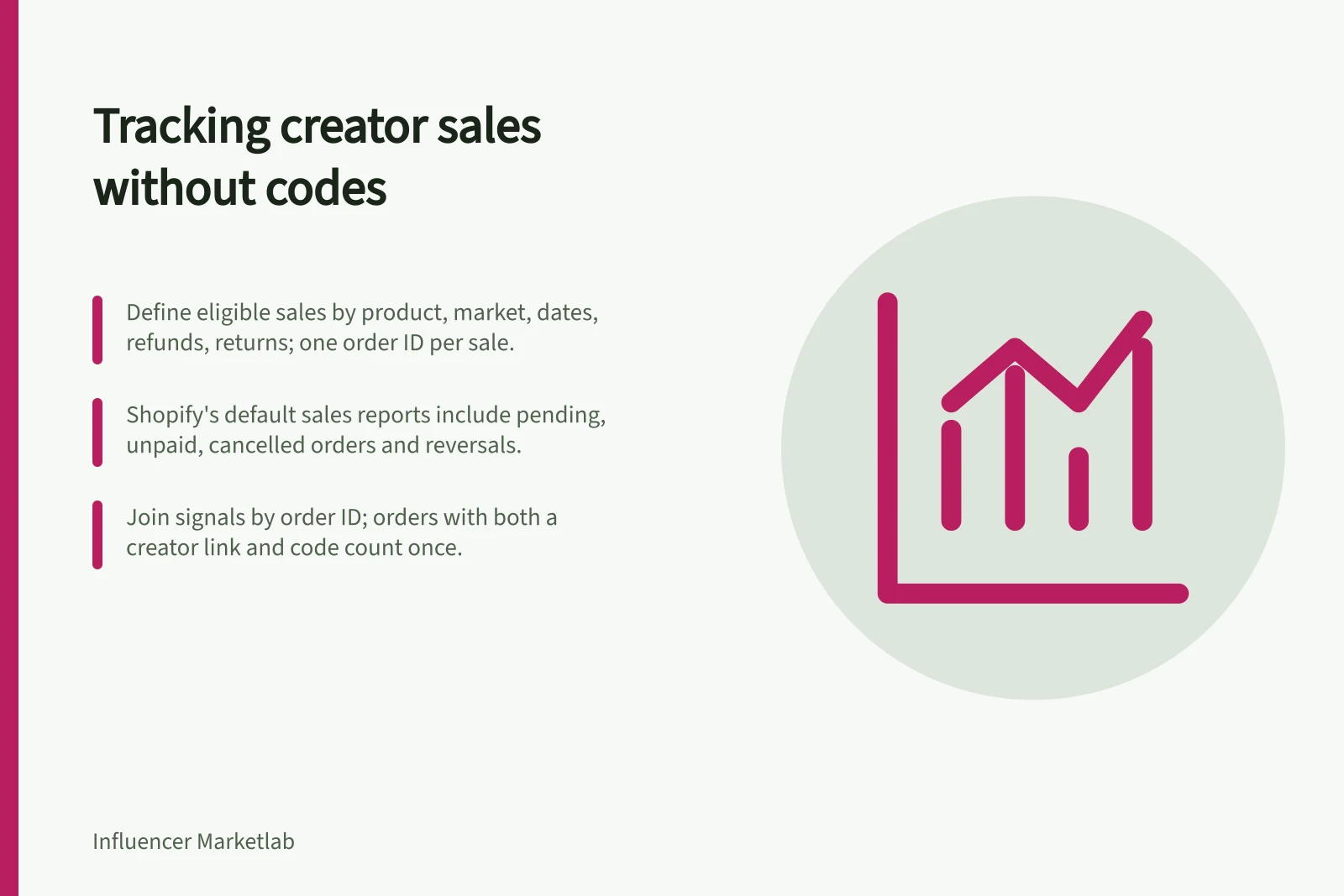
Define an eligible sale in the business’s order system: product, market, order dates, and treatment of cancellations, refunds and returns. Use one order ID per sale in the working dataset. A website purchase event is useful route evidence, but the order record establishes whether the sale meets the business’s rules.
Check the commerce report’s definitions before using its headline total. Shopify’s default sales reports, for example, include pending, unpaid and cancelled orders and record later sales reversals. A business counting retained, paid orders needs to apply its own eligibility rules rather than assume the default report already does so.
If the site sends purchase events to Google Analytics, check whether each web purchase carries a unique transaction ID and whether the recorded value agrees with the order. Google’s guidance describes using transaction IDs to minimise duplicate key events. That feature does not make analytics and commerce records reconcile automatically.
Establishing the eligible order total
- Define an eligible saleSpecify product, market, order dates, and treatment of cancellations, refunds and returns.
- Use one order ID per saleKeep the working dataset at order level, with one record per eligible sale.
- Check the commerce report’s definitionsConfirm whether headline totals match the business’s own eligibility rules.
- Apply the business’s eligibility rulesDo not assume a default report counts only retained, paid orders.
- Check purchase eventsConfirm whether each web purchase carries a unique transaction ID and whether recorded value agrees with the order.
Add signals that do not depend on a code
Use a distinct tagged link for each creator placement that supports one. Record the landing visit and any later order the configured systems can connect to it. Preserve the placement ID and post date so the visit can be assessed against the agreed observation period. Check links and redirects before publication because lost tags weaken the evidence.
Where appropriate, ask buyers how they heard about the product. Make the answer voluntary and allow uncertainty or more than one influence where the form permits. A customer’s recollection is useful, but it is not a verified exposure record. For store or phone sales, staff can record a stated creator mention rather than infer one from a customer’s characteristics.
| Signal | What it establishes | What it misses |
|---|---|---|
| Creator code | The code was applied to an order. | Buyers who forgot it, used another offer or bought where it was unavailable. |
| Tagged link linked to an order | A recorded visit through that link preceded an order under the system’s rules. | Unconnected later visits and exposure without a click. |
| Customer-stated source | What the customer recalls or reports. | Unremembered or unreported influences. |
| Overall order trend | Whether eligible business sales changed. | Which activity caused the change. |
A code can circulate beyond the original post, so redemption is a code-use figure. A buyer may also watch a post, search for the brand and purchase without its link or code. Some visits may appear as direct traffic when their source is unclear; a rise in direct traffic should not be reassigned to the creator merely because it followed a post.
What each code-free sales signal can and cannot establish
- Creator codeEstablishes: the code was applied to an order. Misses: buyers who forgot it, used another offer or bought where it was unavailable.
- Tagged link linked to an orderEstablishes: a recorded visit through that link preceded an order under the system’s rules. Misses: unconnected later visits and exposure without a click.
- Customer-stated sourceEstablishes: what the customer recalls or reports. Misses: unremembered or unreported influences.
- Overall order trendEstablishes: whether eligible business sales changed. Misses: which activity caused the change.
Reconcile before making a claim
Join observable signals by order ID where available. An order with both a creator link and a code counts once in the eligible total. Show overlapping categories explicitly. If the systems cannot reliably join visits to orders, report the visit and order figures separately rather than imply an order-level match.
Put the campaign timeline beside eligible orders: creator posts, brand emails, other ads, promotions, price changes, stockouts and site issues. A rise after a post may warrant investigation, but those events prevent a simple causal reading. If the decision requires an estimate of incremental sales, design a suitable comparison before the next campaign. Do not label every code-free order in the period an untracked creator sale.
Close with the eligible order total, the count carrying each observable creator signal, any measured overlap and the remaining unattributed orders. State when a signal could not be linked to an individual order.
Reconciliation checks before claiming a code-free creator sale
- Join observable signals by order ID where available
- Count an order with both a creator link and a code once in the eligible total
- Show overlapping categories explicitly
- If visits cannot be reliably joined to orders, report visit and order figures separately
- Place the campaign timeline beside eligible orders
- Do not label every code-free order in the period an untracked creator sale
- Close with the eligible order total, signal counts, measured overlap and remaining unattributed orders
- State when a signal could not be linked to an individual order