Results Measurement
Part of Influencer reporting for brand and finance teams
Explaining uncertain attribution to stakeholders
Explain observed orders, recorded creator routes and attribution credit without presenting them as proved incremental sales.
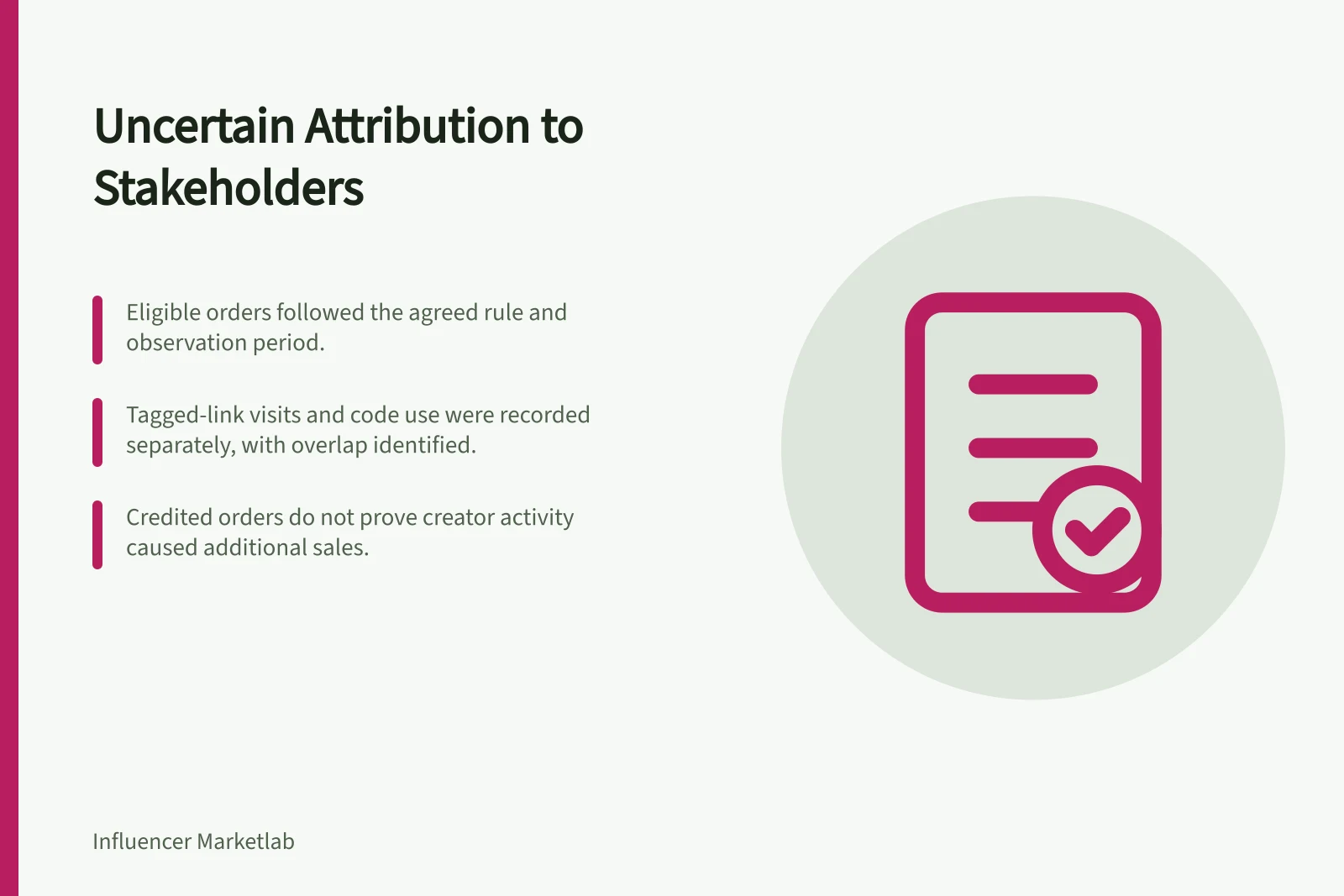
Tell stakeholders what the business observed, which creator routes it recorded and what the reporting system credited. Then say whether those figures can answer the causal question being asked. A credited order is not automatically an additional order caused by a creator.
Lead with three separate statements
First, give the business outcome under its stated rule and observation period: eligible orders, enquiries or another agreed result. Second, report measurable creator routes such as tagged-link visits and code use, noting any overlap that can be identified. Third, explain what remains unknown about incremental effect.
For example, a report could say: “The order total follows our agreed eligibility rule. We show recorded creator-link and code signals separately and remove overlap we can identify. These records do not establish how many additional orders creator activity caused.” This is sample wording, not a finding from a campaign.
Name the source of uncertainty
When implemented, a tagged URL lets Google Analytics identify traffic using that link. It cannot identify someone who saw a post and later arrived another way. A code records its use on an order, but it may circulate beyond the original post. A single order may carry both a link and a code signal.
Google Analytics assigns key event credit under a reporting attribution model. Its attribution reports can include modelled key events. Whether modelling affected a particular reported figure requires checking that property's configuration and report. Neither modelled nor observed credit is a direct measure of incremental creator sales.
| Stakeholder question | What the evidence can support | Claim to avoid |
|---|---|---|
| “How many people came through the creator link?” | Tagged traffic under the stated setup and period | Everyone who saw the content |
| “How many sales did the creator drive?” | Eligible orders with recorded creator signals, with attribution credit separately labelled | Every credited order was caused by the creator |
| “Did sales rise after the posts?” | The observed change and other relevant activity | Timing alone proves the cause |
| “What would reduce uncertainty?” | Better route checks or a suitable comparison planned before the next campaign | A longer lookback window will prove impact |
Explain what the uncertainty changes
If the brief was to explain a product, uncertainty about incremental orders may matter less than whether the content answered the intended question. If a larger investment depends on incremental sales, the available record may be insufficient. A simple before-and-after chart does not isolate creator activity from other changes.
Name the next evidence step that fits the decision: check that campaign parameters survive the link route, agree an eligible-order definition, identify overlapping order signals where systems permit, or plan a suitable comparison before the next campaign. Close with what can be decided from current evidence and what requires a stronger test.