Results Measurement
Measuring the business results of influencer campaigns
Measure influencer campaign delivery, visits and business outcomes while keeping overlapping sales signals and attribution limits clear.
Measure an influencer campaign against the business decision it was meant to affect. Agree the outcome before posts go live, record what was delivered, and connect observable visits, enquiries or orders to the campaign where the data allows. Report those observations separately from any estimate of sales the campaign caused. A view, a code redemption and an attributed purchase answer different questions.
Decide what result matters
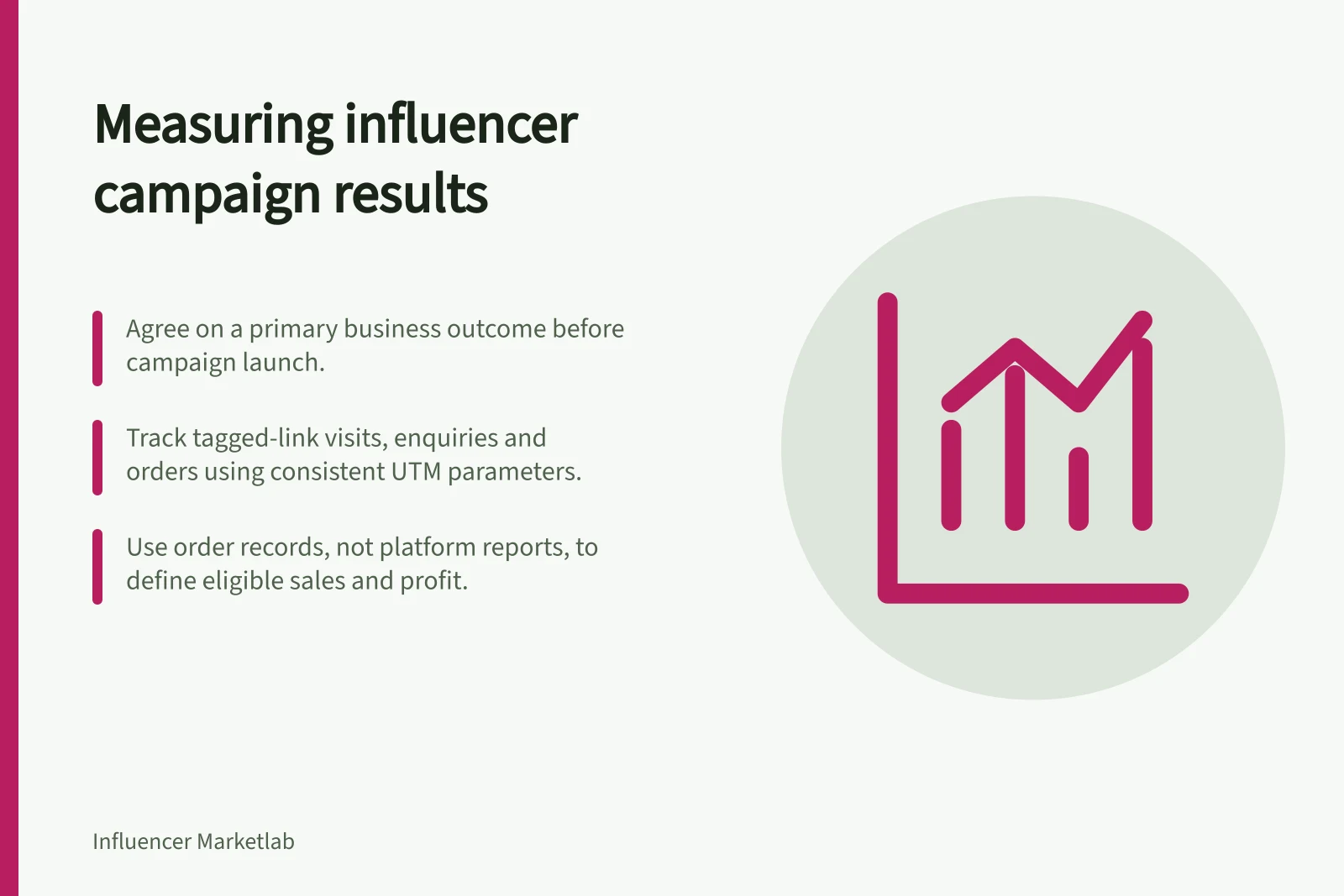
Start with one primary outcome. An introduction to an unfamiliar product may be judged on relevant exposure and subsequent interest. A campaign inviting people to buy an available product needs an order measure as well as a working path to purchase. For a service, a qualified enquiry may be more useful than a raw form submission.
Write the decision the review must support: continue with the creator, change the content, improve the offer or stop the activity. Then choose evidence that could inform it.
| Question | Evidence to record | Limit |
|---|---|---|
| Did the agreed content run? | Final asset, account, format and publication date. | Delivery is not a business outcome. |
| Was it seen? | Post-level reach or views, with the platform and reporting period. | Views can include repeat watching; separate placements can reach the same people. |
| Did viewers use a measurable route? | Tagged-link visits, enquiries and orders, where tracking is implemented. | People may arrive later by search, direct visit or another route. |
| Did business results improve? | Eligible orders, sales or qualified enquiries against a suitable comparison. | A change during the campaign may have other causes. |
Use the business’s order or customer system to establish completed outcomes under its chosen rules. Define whether cancelled or returned orders are excluded and whether sales figures include discounts, tax and shipping. Website analytics and platform dashboards can help explain the route, but their figures need not match the order record.
Key Metrics to Track in Influencer Campaigns
- Delivery Confirmation
- Final asset, account, format and publication date recorded
- Reach/Views
- Post-level reach or views by platform and reporting period
- Measurable Route Usage
- Tagged-link visits, enquiries or orders with tracking implemented
- Eligible Orders
- Completed orders under business-defined rules (exclusions applied)
Top KPIs for Influencer Marketing in Australia
- Conversion Rate from Tagged LinksMeasures effectiveness of call-to-action and landing experience
- Incremental Conversion Value (from Lift Studies)Estimates additional conversions due to campaign exposure, useful for ROI assessment
- Cost per Eligible OrderCombines campaign spend with actual completed orders; reflects efficiency
Check what the sales measure includes
A platform’s sales report may apply conventions that differ from the business’s chosen outcome rules. Shopify sales reports can show orders by time, product or channel. In Shopify, orders are counted by the date they were placed and can include pending, cancelled and unpaid orders; gross sales are product price multiplied by quantity before taxes, shipping, discounts and sales reversals.
Keep revenue and profit measures distinct when judging the result. Shopify defines gross profit as net sales less product cost. If the campaign decision depends on profit, use a measure that accounts for product costs rather than treating gross sales or attributed revenue as profit.
Platform Sales Reports vs Business Order System Definitions
- Sales Report (Shopify)Orders counted by date placed; includes pending, cancelled and unpaid orders. Gross sales = product price × quantity before tax, shipping, discounts or reversals.
- Business Order SystemEligible orders defined by business rules. May exclude cancelled/returned orders. Revenue may include or exclude discounts, GST, shipping and product cost.
Set up a consistent campaign record
Give each creator placement an ID. Record its publication time, link destination, agreed code if any, product, intended market, fee and any paid amplification.
Use consistent tags on links where the placement supports a clickable destination. Keep creator posts, brand organic posts and paid distribution on separate lines. Their reported reach figures should not be added and labelled as distinct people reached.
Before launch, check that tagged links survive redirects, destinations work and any purchase tracking can be compared with order records. A transaction ID can help minimise duplicate key events in Google Analytics, but it does not reconcile the business’s entire order history.
Standardise campaign tags
For Google Analytics, use the same naming rules across campaign links. Google recommends including utm_source, utm_medium and utm_campaign; utm_id can identify a specific campaign or promotion, while utm_content can distinguish creative versions. Consistent values make it easier to compare traffic referred by different placements.
Check that reports show the dimensions you expect. Google Analytics does not include UTM information in Landing page + query string or Page path + query string; it is available in the Page location dimension. A missing tag value in one report view does not necessarily mean the visit was untagged.
Read sales signals without adding them together
A customer can click a creator link, use a code and appear in an attribution report for the same order. Match signals to order IDs where the systems permit. Show orders using a creator code and orders with a recorded creator-link visit as potentially overlapping groups, rather than adding both figures into a sales total.
Codes identify orders on which the code was applied. Tagged links identify visits through that link. Neither captures everyone who saw content and later bought through another route.
An attribution report assigns credit according to its model and lookback window; credited revenue is not revenue proved to have been caused by the creator. Keep total eligible business orders visible and note other promotions, price changes and stock issues.
If the investment decision requires a causal estimate, plan a suitable comparison before launch, such as a carefully designed holdout or geographic test. A before-and-after rise is a reason to investigate, not proof of lift. A small campaign may lack the scale or separation needed for a credible test; state that limit.
Pros and Cons of Attribution Models in Influencer Campaigns
- ProsHelps identify which touchpoints contributed to conversions; useful for optimising future content and media mix.
- ConsAttribution models assign credit based on algorithms; credited revenue is not proof of causation. Overlapping signals can lead to double-counting.
Interpret lift estimates in context
A geographic Conversion Lift study compares exposed and baseline regions to estimate incremental campaign impact. Google Ads reports incremental conversion value, incremental conversion count and incremental cost; incremental return on ad spend (iROAS) is incremental conversion value divided by incremental cost. It represents estimated additional conversion value, not all revenue credited to the campaign.
Read a point estimate alongside its confidence interval, which gives the estimated range in which the result falls. Geographic studies typically require a higher budget, and Google recommends waiting until the study ends for the most accurate results. A post-study cooldown is optional and recommended for clients with a conversion cycle longer than a few weeks.
Turn the evidence into a decision
Review results after the agreed observation period, allowing for reporting delays and later order adjustments. Put the primary outcome first, then explain delivery, reach, measurable routes, eligible orders, costs and material confounders. If comparing costs with revenue, define the revenue basis and include the relevant campaign costs. Revenue divided by creator fees alone is not a profit measure.
End with the next decision. If a creator explained the offer well but sent few measurable visits, a clearer destination may be worth testing when visits were the goal. If attribution remains weak, say what was observed and what further evidence would justify increasing spend.
In this guide
- Separating paid creator reach from organic brand reachSeparate sponsored creator posts, brand organic posts and paid amplification without counting overlapping audiences twice.
- Tracking sales when customers do not use creator codesTrack sales without creator codes using tagged visits, order records and customer-stated sources while avoiding double counts.
- Choosing a campaign attribution windowChoose a campaign attribution window from measurable touchpoints and the buying path, then document settings and reporting limits.