Results Measurement
Part of Influencer reporting for brand and finance teams
Comparing campaigns with different objectives fairly
Compare creator campaigns against their own objectives, matching metric definitions and complete costs without forcing a false ranking.
Compare each creator campaign against the job agreed for it before seeking a common efficiency measure. An awareness campaign and an enquiry campaign can both be useful. Ranking them by views or sales alone changes the question after the work is done.
Give each campaign the same comparison card
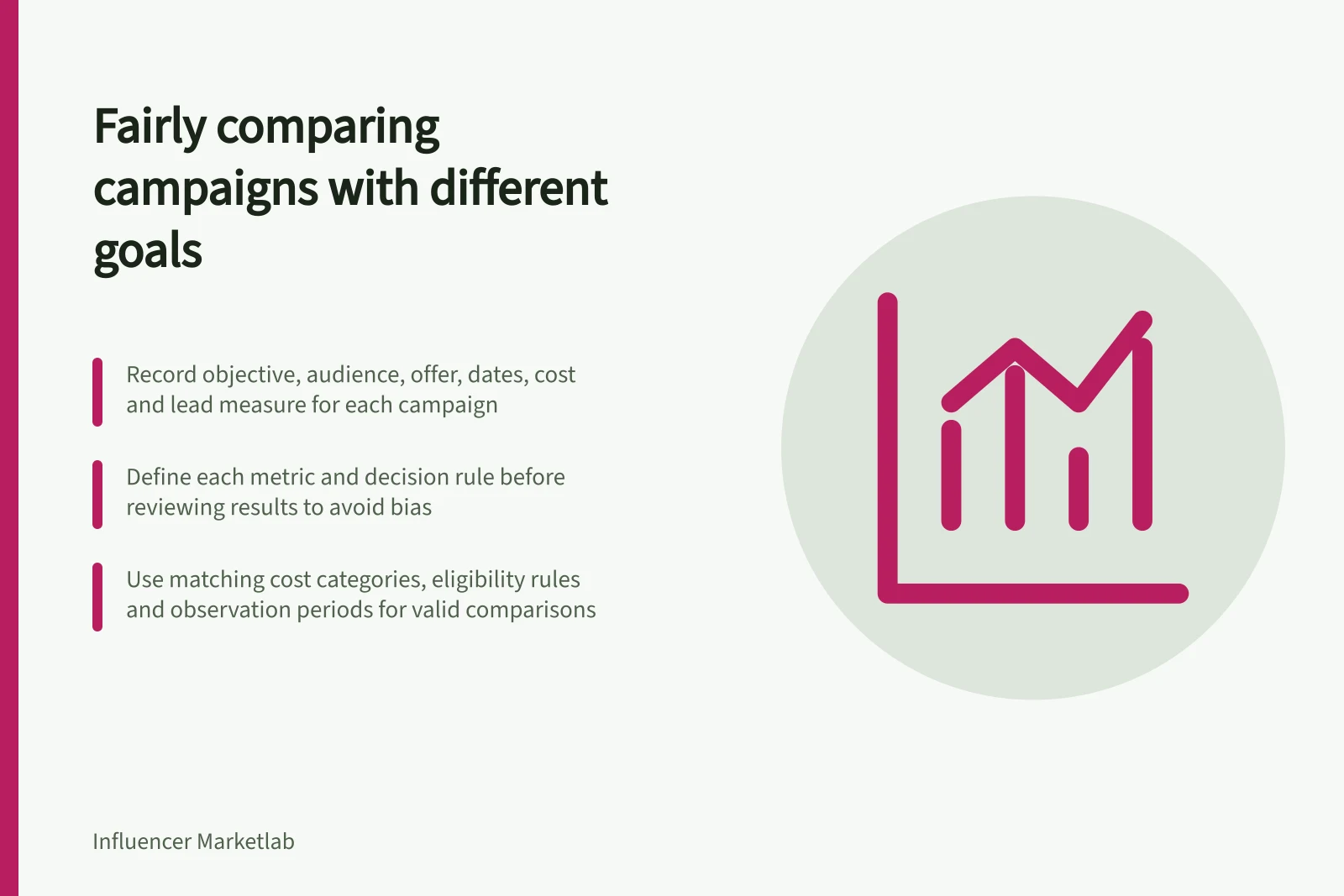
Record the objective, intended audience, offer, dates, placements, relevant total cost, lead measure, supporting measures and known limits. Define each measure and its source. Set down the decision rule agreed before results were reviewed, so the comparison cannot favour whichever figure looks strongest afterwards.
A product demonstration may be reviewed for whether it answered a specified customer question. An awareness placement may be reviewed for relevant reported exposure. Those are different assessments; neither should be converted into the other's objective for the sake of a single ranking.
Decide which figures can be compared directly
| Question | Fair basis | Problem to avoid |
|---|---|---|
| Did the work run? | Accepted assets and publication evidence against each scope | Counting a submitted draft as a live placement |
| Did it serve its objective? | Each campaign's agreed lead measure and relevant quality check | Changing the objective after results arrive |
| What did it cost? | Matching cost categories and GST basis where applicable | Comparing one creator fee with another campaign's full cost |
| Are results directly comparable? | Matching metric, audience, period and eligibility rule | Ranking unlike views, reach, visits and orders |
| What should happen next? | Evidence, uncertainty and current business need | A universal score that hides different jobs |
A cost per reported result helps only when the denominator means the same thing in both campaigns. TikTok Ads Manager defines ad reach as unique users shown an ad at least once, and ad impressions as times ads were shown. The two cannot substitute for each other in a cost comparison.
Where campaigns share an outcome, align its eligibility rules and observation period. If one order count excludes returns and another does not, reconcile the definitions or show the difference. Use the full cost relevant to the decision, including creator work, production, media and priced content use where applicable.
Key Metric Definitions from Platform Sources
- TikTok Ad ReachUnique users shown an ad at least once
- TikTok Ad ImpressionsTimes ads were shown
- YouTube Views (as per Google)Number of times a video has been watched, including multiple views by the same user
- Google Analytics Traffic SourceIdentifies traffic using correctly tagged links; does not capture non-click influences
State what the comparison cannot settle
Correctly tagged links can identify traffic using those links in Google Analytics. They cannot identify everyone influenced without a click. A cost-per-visit calculation describes observed traffic and spending; it does not prove the campaign caused the visits or later orders.
Do not add separate reach or unique-viewer figures and label the sum a distinct audience. Use a combined audience measure only when its documented scope covers the placements being compared.
The final decision may be that one campaign supplied more reported exposure while another answered a customer question more clearly. It may also be that the evidence is too different for a direct efficiency ranking. State which objective the business needs next and what evidence would make a future comparison stronger.