Budgets and Fees
Part of Product gifting and seeding programmes
Tracking seeding costs without treating gifts as guaranteed coverage
Budget for product seeding as an experiment in relevant creator relationships, not as a fixed number of posts purchased for the price of goods.
Treat product seeding as an experiment in relevant creator relationships, not a fixed number of posts bought for the price of goods. Record every material cost and separate a no-obligation gift from a commissioned deliverable.
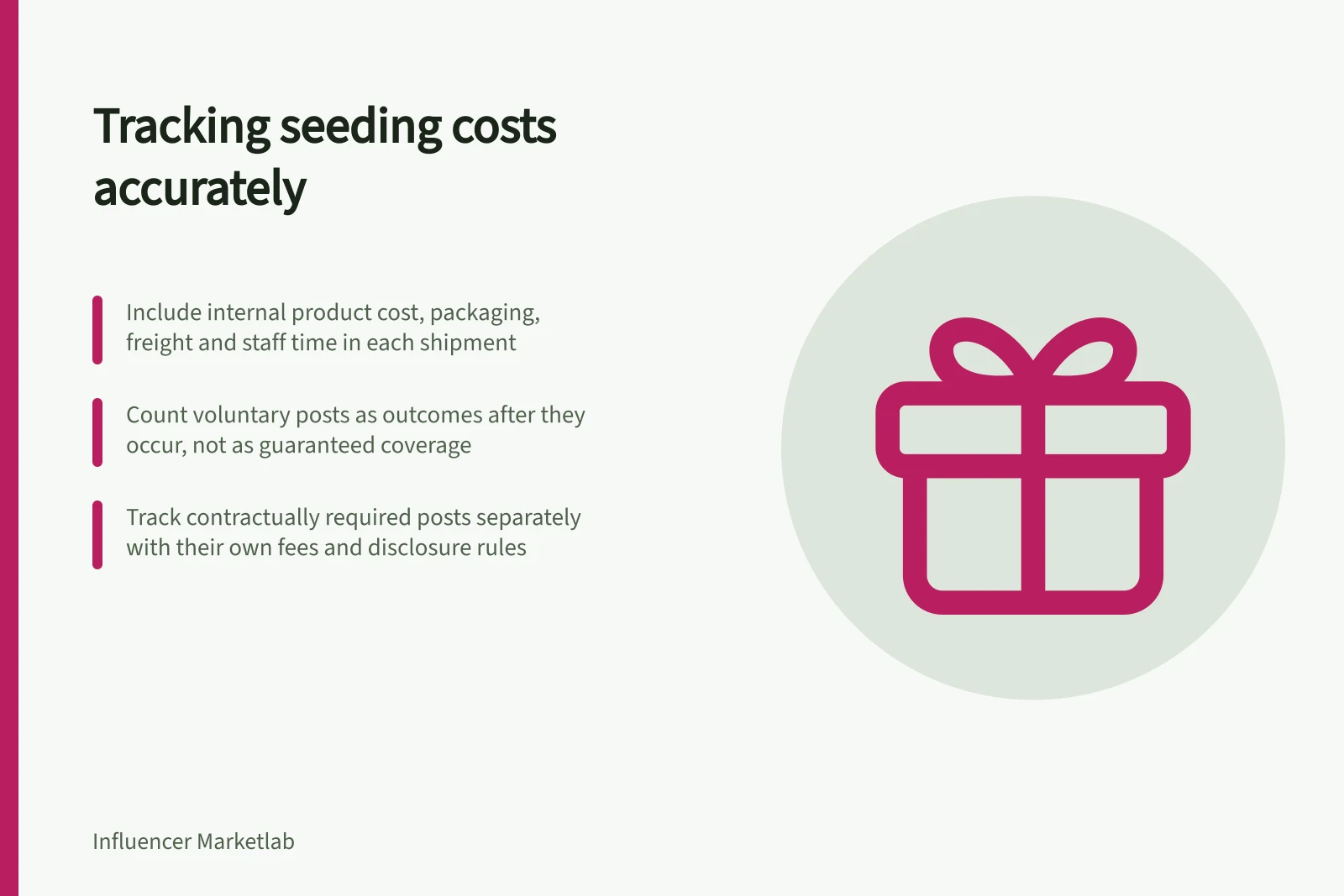
A no-obligation gift has a cost whether or not it earns a mention; it is not a purchase of coverage. Count voluntary posts as outcomes after they occur, and track contractually required posts separately.
No-Obligation Gift vs Commissioned Post: Key Differences
- Nature of ArrangementNo-obligation gift – no requirement to post or disclose
- Disclosure RequirementMust be disclosed if content is published; no obligation to disclose if unused
- Cost TreatmentTreated as an experiment cost; not a purchase of coverage
- Contractual FeeNone – fee only applies if content is commissioned
- Outcome TrackingTrack voluntary posts after they occur; do not assign monetary value
Count the complete shipment
Include the product's internal cost, packaging, freight, duties if relevant, replacement units and staff time spent selecting, coordinating and following up. Retail value can provide useful context, but it is not the cash or opportunity cost to the business. Keep the accounting basis consistent when comparing rounds.
Use the product's internal cost consistently, and record retail value separately if it is useful context. Log staff hours and apply the same documented internal hourly rate when costing each round, so comparisons use the same basis.
A seeding log can include recipient, item, shipment date, terms, internal product cost, packaging, freight, duties, replacement units, staff hours and rate, outcome, disclosure status and documented downstream outcomes. Keep each shipment as a row and retain the terms that show whether content was optional or commissioned.
Record the recipient, item, date, terms and outcome. Outcomes can include a post, private product feedback, a later paid collaboration or no response. Do not assign the same monetary value to each. If a post was contractually required, track it separately as a commissioned arrangement with its own fee and disclosure requirements.
Compute cost per shipment by dividing the round's attributable costs by the number of shipments. For no-obligation seeding, cost per voluntary post is the round's cost divided by the voluntary posts published; treat this as a retrospective average, not a price paid for guaranteed coverage.
For commissioned posts, report the contract fee and attributable product and fulfilment costs separately, then compare them with the number of contracted posts. Do not combine that result with voluntary mentions from no-obligation gifts.
The ACCC says the Australian Consumer Law prohibits businesses from misleading or deceiving consumers, and applies to influencers engaging in trade or commerce as well as brands and marketers. The ACCC reported that many influencers it reviewed had not adequately disclosed apparent payment, gifts or other incentives to promote brands.
In the ACCC's PhotobookShop case, the business paid $39,600 in penalties after receiving two infringement notices for alleged misleading influencer reviews posted on Instagram. Between August 2024 and September 2025, it commissioned social media reviews and, on 107 occasions, instructed influencers not to disclose free products supplied for the reviews.
The ACCC reported that the gifted products in the PhotobookShop matter were valued at around $50 to $400. That case value is not a measure of a business's internal product cost, freight or staff time.
The ACCC's PhotobookShop case involved reviews commissioned in exchange for free products and not adequately disclosed. It should not be used to infer that a product sent with no content obligation buys coverage.
Key Costs in Product Seeding (ACCC-Compliant Tracking)
- Internal Product Cost
- Record consistently using internal cost, not retail value
- Packaging & Freight
- Include all shipping and packaging costs
- Duties (if applicable)
- Add relevant import duties for international shipments
- Replacement Units
- Account for any replacements sent during the round
- Staff Time
- Log hours using a documented internal hourly rate
ACCC Enforcement Example: PhotobookShop Case
- August 2024 – September 2025Period of alleged misleading influencer reviews
- Infringement Notices IssuedTwo notices issued by ACCC for non-disclosure of free products
- Penalty Payment$39,600 paid by PhotobookShop
- Product Value Range$50 to $400 per gifted item
Review without inventing return
Report shipments, total cost, voluntary mentions, useful feedback and any documented downstream outcomes. Avoid calculating a precise return from impressions alone when sales attribution is uncertain. If few items are used, revisit product fit and briefing before sending more packages.
Keep usage rights out of the seeding-cost assumption. Reposting or advertising a creator's material may need a separate agreement and budget even when the product was gifted.