Budgets and Fees
Budgeting for revisions, travel and content reuse
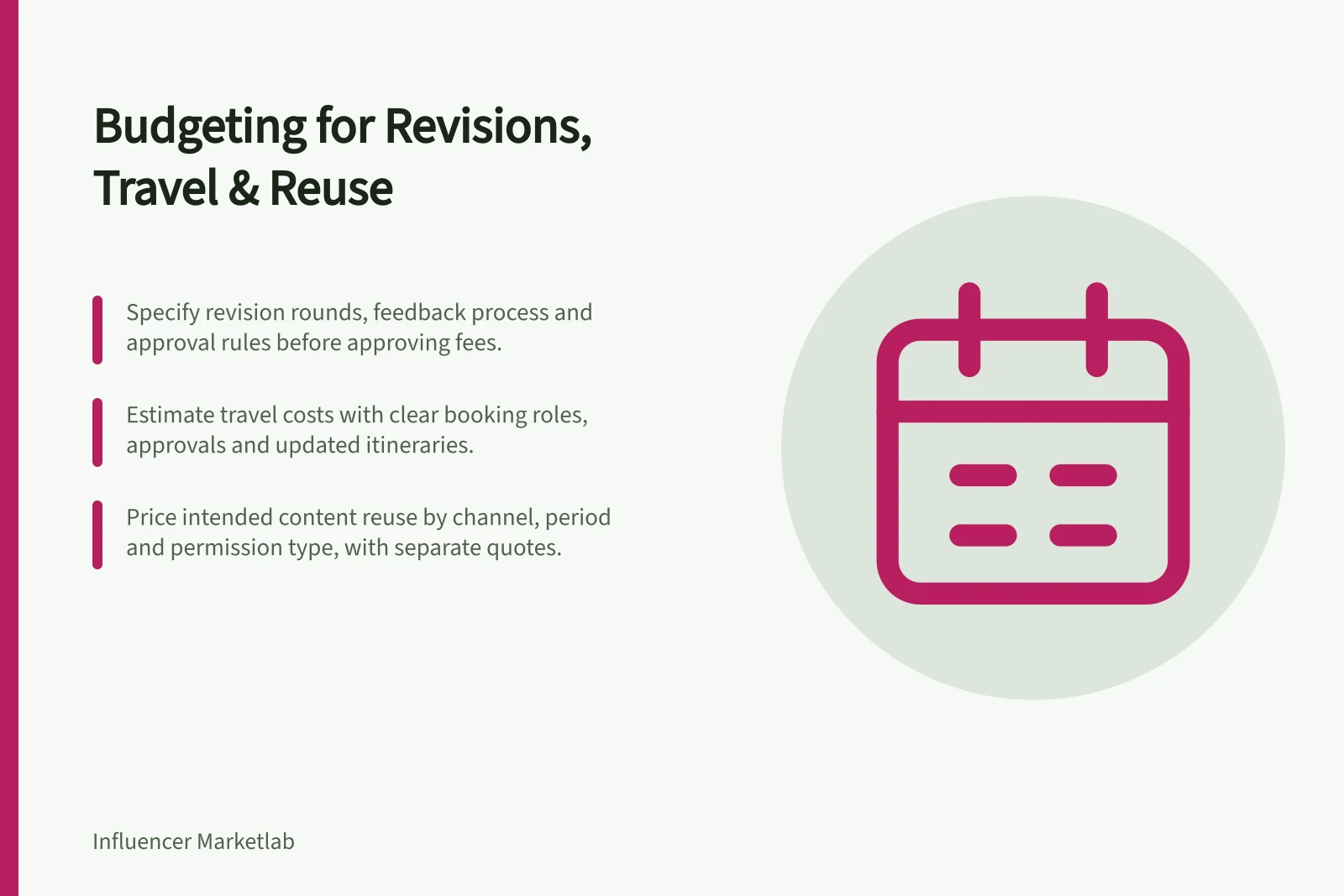
Price creator revision rounds, travel and content reuse with clear scope, quote status and approval rules.
Price revisions, travel and intended content reuse before approving a creator’s base fee. Each can change either the work required or the permission the brand needs. Record what the fee includes, use a separate quote or labelled allowance for unresolved costs, and agree who can approve a change.
Define the revision boundary
Specify the asset under review, the number of included feedback rounds, who sends consolidated comments and when feedback is due. A correction to an agreed factual error may be treated differently from a new request for another product angle, format or reshoot. Agree that treatment with the creator.
Define what counts as one round and what requires a fresh quote. If brand reviewers send conflicting notes, one contact should resolve them before the creator works again. Keep the approved brief and asset version with the feedback so an added request is visible.
Do not publish an inaccurate product claim because the revision allowance is exhausted. Pause the affected content, agree the correction and record any additional production cost. Australian consumer guidance requires advertising claims to be accurate and supported.
Australian Compliance Requirements for Creator Content
- Accurate claims under ACCC rules
- Advertising must be truthful and supported by evidence
- Copyright ownership (AG.gov.au)
- Creator owns original work unless transferred in writing
- Reused content permissions
- Must be explicitly granted in contract or separate agreement
Estimate travel from the actual plan
A location shoot may involve fares, local transport, accommodation, agreed meals, equipment carriage and time away from other work. Record which items the brand books, which the creator arranges and which the fee already includes. Seek an itinerary and quote before replacing an allowance with a commitment.
Name who can approve a changed flight, an extra night or another visit. State whether travel is reimbursed against agreed costs or paid as a fixed amount under the arrangement. If the venue or date changes, update both the travel estimate and production schedule. A promise to ‘cover travel’ without scope or approval limits leaves the total uncertain.
Price the reuse the brand intends
Identify the assets the brand wants to use: a published post, clean export, stills or another cut. State the intended channel, period and any editing or third-party use. Creator publication and brand advertising are different uses to discuss and price.
Put the quoted reuse fee, or a clearly unresolved allowance, beside the production fee. If the brand later wants another placement or a longer period, check the agreement and obtain any additional permission and price before that use.
A budget entry does not grant copyright permission. Check third-party material, including music and images, before assuming it can be used in a new edit or ad.
Keep approvals in one view
A short schedule can show three rows: included revision rounds and the process for extra work; approved travel items and ceiling; and the reuse being priced. Give each row an owner, quote status and approval date. Update price and timing together when scope changes, then compare the final invoice with the approved schedule.
There is no universal number of included edits, travel allowance or reuse fee. Those amounts depend on the production and agreement; the useful decision is to make each cost and permission explicit.