Budgets and Fees
Influencer campaign budgets and Australian creator fees
Plan an Australian influencer campaign budget, compare creator fees on a consistent scope and track production, media and reuse costs.
Build the budget around the work the campaign needs, then add the costs to deliver it. A creator’s fee is one line: product supply, production, travel, management, paid media and content reuse may also need funding. Set a spending ceiling before booking and compare quotes on the same scope.
Set the campaign ceiling
State the audience and what the content must do, then decide which deliverables to price. Record the total amount the team can approve, separate confirmed commitments from costs awaiting quotes, and allow for foreseeable changes. An allowance covers an approved change; it is not permission to expand the brief without a decision.
Build the approval ceiling by adding quoted creator fees, other quoted delivery costs, internal estimates and a separately identified allowance. Record each item on the same GST basis, then compare the total with the amount the team can approve.
Treat the approved amount as a cap. If a revised quote pushes the forecast above it, reduce the scope or obtain approval before committing.
Business Queensland identifies capacity, such as insufficient staff time, and capability, such as a need for specialist marketing skills, as common reasons to outsource. This helps distinguish a creator fee from other support costs the campaign may require.
When weighing in-house and external work, consider the task’s complexity, whether the skills are needed for a one-off project or ongoing, and whether there is enough work to justify dedicated staff. Compare each option’s cost with its likely benefits; many businesses combine internal and external skills.
My Heart Studio’s 2026 Australian guide recommends planning across nano, micro, macro and celebrity partners because average costs vary by tier. Use the tier mix to organise planning, then build the ceiling from quotes for the agreed work.
Compare creator fees on the same scope
Ask each creator to quote for the proposed formats, number of assets, publishing account, production and posting windows, review rounds, product access and reporting. A cheaper quote is not comparable if it excludes filming, another cut or time needed to demonstrate the product.
If proposals differ in scope, request revised quotes against the same deliverables before comparing prices. Consider audience relevance, the creator’s ability to explain the product, production demands and timing. Ask for recent results from comparable formats where available, but do not treat past figures or follower count as a forecast.
Compare several Australian quotes for the same scope and treat published rate guides as a rough reference, not a target. Fees vary with factors including audience scale, engagement, niche, platform and content format, so ask about differences you cannot explain.
Snippet’s 2026 Australian rate snapshot lists sponsored posts at A$70–A$400 for nano creators (1,000–10,000 followers), A$400–A$3,000 for micro (10,000–50,000), A$3,000–A$12,000 for mid-tier (50,000–500,000) and A$12,000–A$30,000 for macro creators (500,000–1 million).
For video, the same snapshot lists A$150–A$700 for nano, A$700–A$6,000 for micro, A$6,000–A$30,000 for mid-tier and A$30,000–A$85,000 for macro creators. Treat these as indicative bands: a quote still needs to match the campaign’s format and scope.
Megadonkey’s 2026 Australian guide gives another reference for creators with 1,000–20,000 followers: A$50–A$500 per piece of content. It places creators below 5,000 followers at A$50–A$200 and those with 10,000–20,000 at A$250–A$500.
Within Megadonkey’s format bands, creators with 1,000–5,000 followers are listed at A$50–A$200 for an Instagram post, Reel or TikTok video, A$25–A$100 for a Story, and A$100–A$250 for a UGC video. For 5,000–10,000 followers, the figures are A$150–A$400, A$50–A$150 and A$150–A$350 respectively.
For 10,000–20,000 followers, Megadonkey lists A$250–A$500 for an Instagram post, A$300–A$500 for a Reel or TikTok video, A$100–A$250 for a Story and A$250–A$400 for a UGC video. Compare quotes on the same format and deliverables rather than treating a follower band as a fixed price.
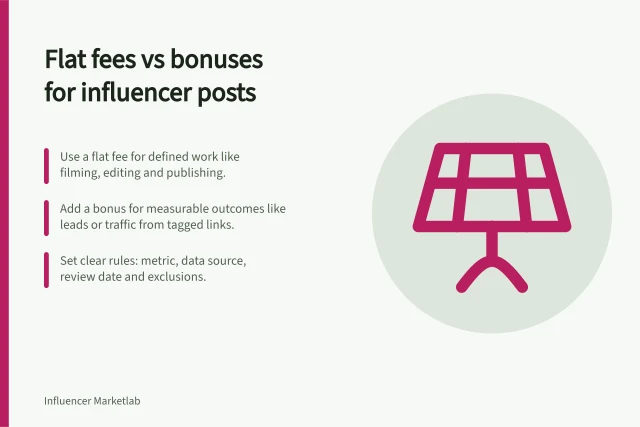
A flat fee fixes the price of the agreed work. A fee with a performance bonus can add variable campaign costs. Neither arrangement guarantees reach or sales.
Assess quote completeness
Request a written quote that describes the work and makes the price clear. Business.gov.au says that if a customer accepts a quote, it becomes a legally binding contract.
Check that costs are itemised as well as totalled, and that GST is identified where applicable. Look for any variations or revisions already discussed and for payment terms so you can compare proposals and check the total against your approval basis.
For an Australian supplier, ask for the business name, ABN and contact details on the written quote, along with your business name and contact details. Record the payment due date, any late-payment terms and the preferred payment method.
Check the quote’s start and finish dates and expiry date before approving it. Confirm that its price and scope are still current when you are ready to commit, and keep the customer and supplier details clear in the written record.
Key Considerations When Comparing Influencer Quotes
- Written Quote Required
- Yes – legally binding if accepted
- GST Inclusion Clarified
- Must be explicitly stated
- ABN and Business Details Included
- Required for Australian suppliers
- Payment Terms Specified
- Due date, late fees, method
- Scope and Expiry Dates Confirmed
- Must match current campaign plan
Include the full delivery cost
Budget line / What to check
- Creator work
- Assets, posts, review rounds and reporting included in the fee.
- Product and production
- Product supply, freight, venue, props or specialist help.
- Travel
- Transport, accommodation and any separately charged time.
- Content reuse
- Assets, intended brand uses and duration to be priced.
- Paid media
- Advertising spend and management, separate from creator work.
- Campaign management
- Briefing, approvals, coordination and reporting.
- Changes
- Allowance and approval owner for extra work.
Label each amount as a confirmed quote, an internal estimate or an allowance. For Australian quotes, record whether GST applies and whether each figure includes it; calculate the approval total on a consistent basis. If an agency manages the campaign, distinguish its fee from costs it passes through so an item is not counted twice.
Do not infer GST inclusion from a total alone: ask whether GST applies and whether each amount includes it. For planned content reuse, confirm that the proposed use is covered before committing the budget.
Control commitments and review spend
Track the estimate, approved commitment, invoice and actual spend in one view. Mark a shortlisted creator’s fee as provisional until the scope and price are accepted. If an asset, location or schedule changes, agree the revised work and cost before production proceeds, and give one person authority to approve additions.
If a change would take the forecast above the ceiling, pause and seek approval or adjust the scope before proceeding. Do not treat an unused allowance as permission for unapproved work.
After delivery, compare actual spend and delivered work with the approved plan, and record unused allowances. For tagged links, use consistent UTM source, medium and campaign values, then check referred traffic in Analytics.
In this guide
- What belongs in an influencer campaign cost estimateBuild an influencer campaign estimate with clear cost lines, quote status, GST treatment, projected total and approval conditions.
- Flat fees versus performance bonuses for sponsored postsCompare flat creator fees with bounded performance bonuses and define measurable payment terms before a sponsored post runs.
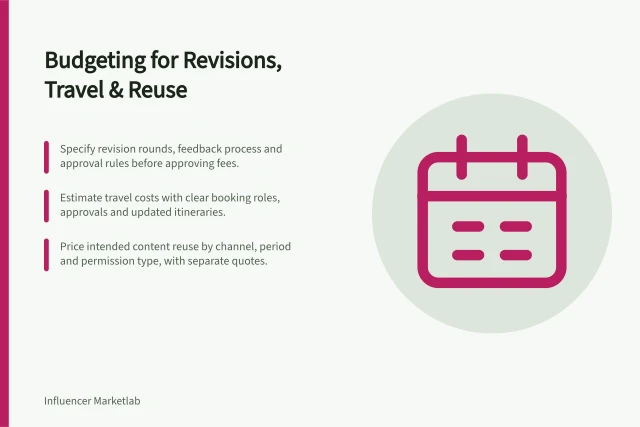
- Budgeting for revisions, travel and content reusePrice creator revision rounds, travel and content reuse with clear scope, quote status and approval rules.