Budgets and Fees
Flat fees versus performance bonuses for sponsored posts
Compare flat creator fees with bounded performance bonuses and define measurable payment terms before a sponsored post runs.
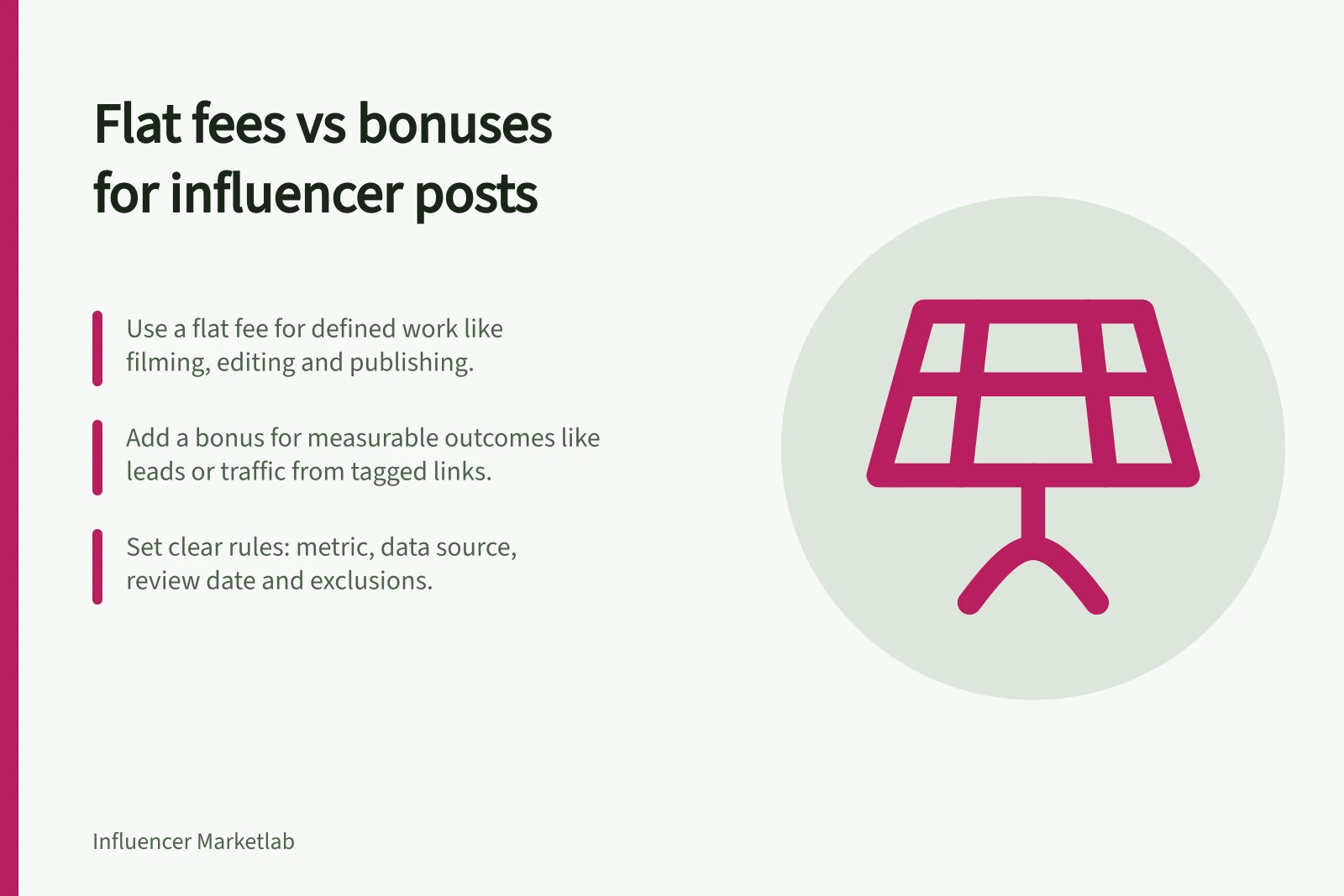
Use a flat fee when the main obligation is to create and publish specified work. Consider a performance bonus when both parties can define the outcome, check it against agreed data and accept what that data cannot measure. Pay for the agreed work through a clear base fee, then set any bonus trigger and maximum payment before the post goes live.
Decide what each payment covers
A flat fee can cover filming, editing, a stated number of revisions, publication and reporting. It gives the creator a known payment for the agreed work and the brand a known base cost. Price a new format or reshoot as a change rather than assuming it is included.
A bonus pays for an additional condition. The parties need to define the eligible action, whose data is used, when it is read and how corrections are handled. Show the base fee and maximum possible bonus separately in the budget so the full commitment fits the campaign ceiling.
| Question | Flat fee | Fee plus bonus |
|---|---|---|
| What can be budgeted at signing? | The agreed fee and priced extras. | The base fee and maximum possible bonus. |
| What must be defined? | Deliverables, revisions and payment timing. | Those terms plus the metric, data source, period and exclusions. |
| Main practical risk | Extra work is requested without repricing. | Incomplete or disputed measurement affects payment. |
This comparison is a way to plan terms, not evidence that either model produces better results.
Write a bonus rule that can be checked
State what counts as an eligible action, the measurement start and end dates, the data source, the review date and who may inspect the result. Decide whether cancelled orders, duplicate leads, returns or activity outside the period count. If the required distinctions cannot be measured reliably, use a simpler trigger or a flat fee.
Correctly implemented tagged links in Google Analytics can identify traffic arriving through those links. They cannot capture everyone who saw a post and later arrived another way. An attribution report assigns conversion credit under a model; it does not directly count sales caused by the creator. Avoid basing payment on a number the creator cannot check or that one party can redefine after publication.
A hypothetical agreement could use a base fee plus an amount for each eligible action above a stated threshold, subject to a maximum bonus. The parties would negotiate the action, threshold and amounts for that campaign; this is a formula, not a market rate.
Keep incentives compatible with honest content
Do not make a bonus depend on a favourable opinion or an unsupported product claim. A creator should be able to describe their actual experience. Check product facts and make the sponsored relationship clear to viewers. A bonus must not reward concealment of that relationship.
Agree when the base fee is payable and when bonus data is final. Specify how an error will be raised and what happens if the destination fails or the offer changes during the measurement period. Apply those agreed terms rather than inventing a payment rule after publication.
Choose the arrangement both parties can administer. Where the outcome is uncertain or mostly outside the creator’s control, pay for the defined work and use observed results to inform the next campaign. If a bonus is useful, keep it bounded and measurable.