Creator Sourcing
Finding creators who fit a brand
Define the customer question, find relevant creators, assess their content and audience evidence, and resolve claim risks before booking.
Start with the customer question a creator must help answer. A good fit is someone who can address that question in their usual voice, reach a relevant audience and represent the product honestly. A familiar face or a large follower count is a reason to investigate, not a booking decision.
Define the job before looking at accounts
Write a short working brief: who the intended customer is, what they need to understand, what the creator could show or explain, and what the customer can do next. Include where the offer is available. For an Australian campaign, a creator living in Australia does not establish that their viewers are in the places the business serves.
Keep the brief narrow enough to judge candidates. “Show renters how this desk fits a small room” gives a furniture creator a possible demonstration. “Make the brand feel relevant” leaves both the content and the audience unclear. Check that the product, page and claims are ready before asking anyone to promote them.
Look for a credible content angle
Search for the customer’s question and related product uses, then inspect creators who address them in ordinary posts and community conversations. Record the reason each account might fit. A creator who regularly discusses a category may be useful for a detailed explanation; another may show an everyday use case. Neither description predicts campaign results.
Read ordinary posts alongside sponsored ones. Can the creator explain a choice without repeating a script? Do they show the conditions in which they used a product? If their usual work relies on humour or quick edits, consider whether that style can carry the detail your brief requires.
Look for relevant audience questions, but treat comments as examples of conversation, not proof of who the whole audience is.
Ask whether the proposed story is honest for this person. A firsthand recommendation needs firsthand experience. A technical demonstration needs the right product, access and time. If those conditions are unavailable, change the content job or the candidate. Australian consumer guidance says social media product claims must be accurate and not misleading.
Follow search trails to find candidates
Search relevant hashtags, location tags and mentions of the brand to surface accounts already discussing related products or uses. Treat these as discovery routes, not evidence that a creator is suitable: check each account against the customer question and the content they normally publish.
A location tag can help you find locally relevant posts, but it does not establish where an account’s audience lives. Keep that distinction in the candidate record and seek audience evidence separately when geography matters.
Compare evidence that answers the brief
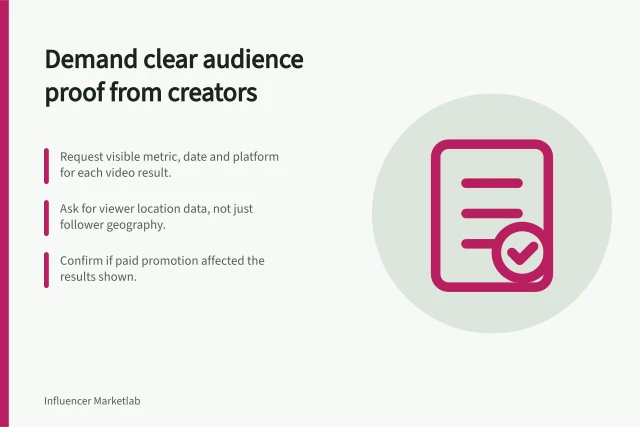
Request recent results for content similar to what you would commission, stating the format and reporting period. Ask for available audience geography if location matters, and note when each figure was captured. A follower total describes an account, while a past post’s views describe that post; they are different measures.
Available platform data can have limitations, including limited geography data on YouTube. Record the source, date and any limitations.
| Question | What to record |
|---|---|
| Can they answer the customer question? | A relevant ordinary post and the proposed content angle. |
| Can they represent the offer honestly? | Product access, experience needed and claims requiring verification. |
| Is the audience plausible? | Available recent audience and post evidence, with format, date and geographic limits. |
| Can the work happen? | Availability, deliverables, review needs and the quote for that work. |
| What remains uncertain? | Missing data and untested creative assumptions. |
Key Factors to Assess When Choosing an Influencer
- Can they answer the customer question?
- A relevant ordinary post and the proposed content angle.
- Can they represent the offer honestly?
- Product access, experience needed and claims requiring verification.
- Is the audience plausible?
- Available recent audience and post evidence, with format, date and geographic limits.
- Can the work happen?
- Availability, deliverables, review needs and the quote for that work.
- What remains uncertain?
- Missing data and untested creative assumptions.
Apply clear booking conditions
Before booking, resolve any fact the creator would need to assert. The finished content must not promise a price, feature, delivery time or result that the brand cannot support. Make a paid or gifted relationship clear to viewers; the ACCC warns that undisclosed paid reviews may mislead consumers. Review the video, on-screen words, caption and destination together.
Agree the actual work: format, publishing account, product access, draft and posting windows, approval contact and payment. Discuss any reuse of the asset separately. If a creator has to adopt an untrue personal opinion, hide a material limitation or present a trial they have not done, the proposed collaboration fails the fit test even if the audience looks attractive.
In March 2026, the ACCC reported that Tomsem Consolidated, trading as PhotobookShop, had paid $39,600 in penalties after receiving two infringement notices relating to alleged misleading influencer reviews on Instagram.
The ACCC said that, on 107 occasions between August 2024 and September 2025, PhotobookShop instructed influencers not to disclose that free products were provided for reviews. It also issued a separate notice after the business edited a review to remove negative comments. Do not agree to conceal a gifted relationship or to change a creator’s genuine account into a misleading endorsement.
Influencer Marketing Compliance Risks in Australia
- ACCC Penalty Amount (2026)$39,600
- Number of Misleading Reviews Identified107
- Time Period of ViolationsAugust 2024 – September 2025
- ACCC Guidance on DisclosurePaid or gifted relationships must be clearly stated to viewers.
Choose, then learn from the booking
Select the person whose evidence and proposed piece best answer the brief, with unresolved risks made explicit. If two creators serve different questions, give each a distinct role. A bounded first booking can test whether the planned content is useful, provided both sides agree what will be delivered and reviewed.
After publication, compare the delivered piece with its intended job and record audience questions and available post results with their limits. Use that evidence to refine the next choice.
In this guide
- Evaluating creator content beyond follower countsReview ordinary and sponsored posts for relevance, clarity, genuine experience and comparable results before choosing a creator.
- Comparing niche specialists with lifestyle influencersChoose between a niche specialist and a lifestyle creator by the customer question, the content each can make credibly and the evidence behind it.