Brief Writing
Part of Working with B2B influencers and industry experts
Turning a technical product into a useful expert discussion
Frame a technical expert discussion around a buyer decision, verified product behaviour, visible limits and useful next steps.
Build the discussion around a decision the buyer must make. Show where the technical product helps, what conditions its use requires and what remains the buyer's responsibility. Give the expert checked facts and appropriate access, and let them ask the questions a practitioner would ask.
Choose one decision
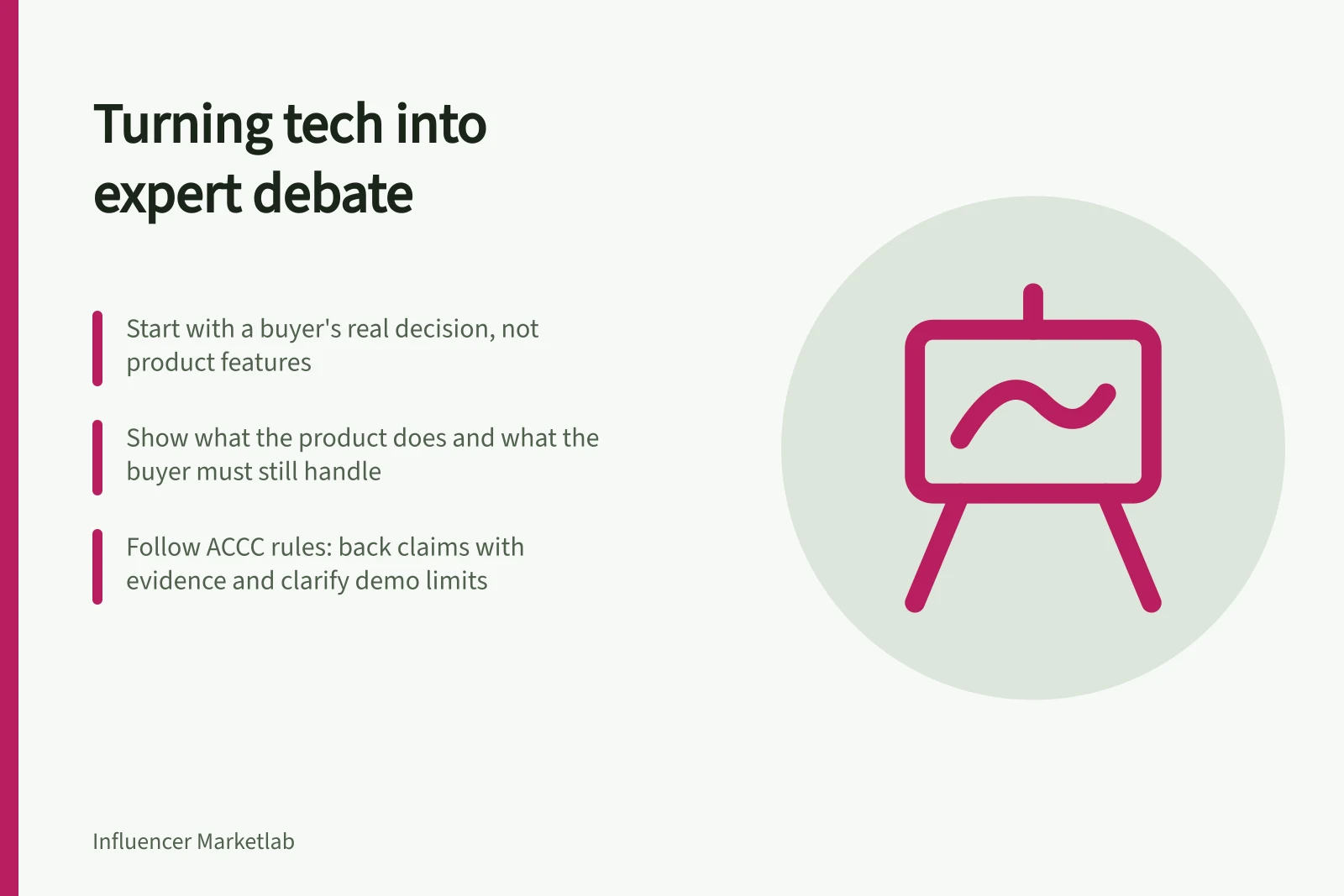
Start with a situation rather than a feature list. A team considering a reporting tool may need to know how records enter it, what happens when a source fails and who investigates discrepancies. The product may answer part of that problem; the discussion should make the whole decision clearer.
Write a question a buyer could ask in a meeting. Define what the audience already knows and what it should be able to assess afterwards. The same question can be explored in different formats; choose the format separately from designing the explanation.
Map claims to evidence
Give the expert a short fact sheet with the current product version, accessible functions, prerequisites and evidence for proposed claims. Mark planned features as planned. Name who will answer technical questions and check a demonstration against the current product.
A useful prompt sequence is:
- What should the buyer diagnose before choosing a tool?
- Which approaches could address the problem, and when would they be unsuitable?
- What does this product do in the relevant workflow?
- Which configuration, integrations, data quality or staff effort remain with the buyer?
- What should the buyer verify in their own environment?
The sequence is an editorial aid; it does not require an expert endorsement.
Show the demonstration's boundary
State whether viewers are seeing a live product, a prepared environment or a brand-supplied example. Identify the version and the conditions behind any result. If configuration or another service is needed, explain that alongside the result.
For a hypothetical monitoring product, an expert might trace an alert through review and escalation, asking who owns a false alarm and what happens when a data feed stops. The brand would verify any functions shown. This is a proposed discussion, not a report of testing.
The Australian Competition and Consumer Commission says it can require businesses to back up claims about their products or services and may investigate and take compliance or enforcement action if a business misleads. Review the slides, screen recording, spoken claims and edited clips as viewers will encounter them. A qualification at the end cannot repair an unsupported central promise.
Protect the expert's judgement
Agree the topic, access, preparation, review contact and publication window. Separate correction of a product fact from a request to change an opinion. The expert should be free to say that a use case falls outside the product's current scope.
If the discussion is commercially supported, make the relationship clear in each finished placement, including clips that may circulate without the full introduction. Finish with a buyer action that follows the discussion: a checklist, a technical question or a request for a demonstration with stated boundaries.