Brief Writing
Part of Influencer campaigns for new product launches
Handling product changes after creators have filmed
Review filmed creator content against a changed product, choose an accurate edit or new footage, and agree revised work before launch.
When a launch product changes after filming, use this sequence for every asset: fact-review it against the version customers will receive, then edit, arrange new footage or hold publication. Check the overall impression across the video, caption and destination, not just a claim in isolation.
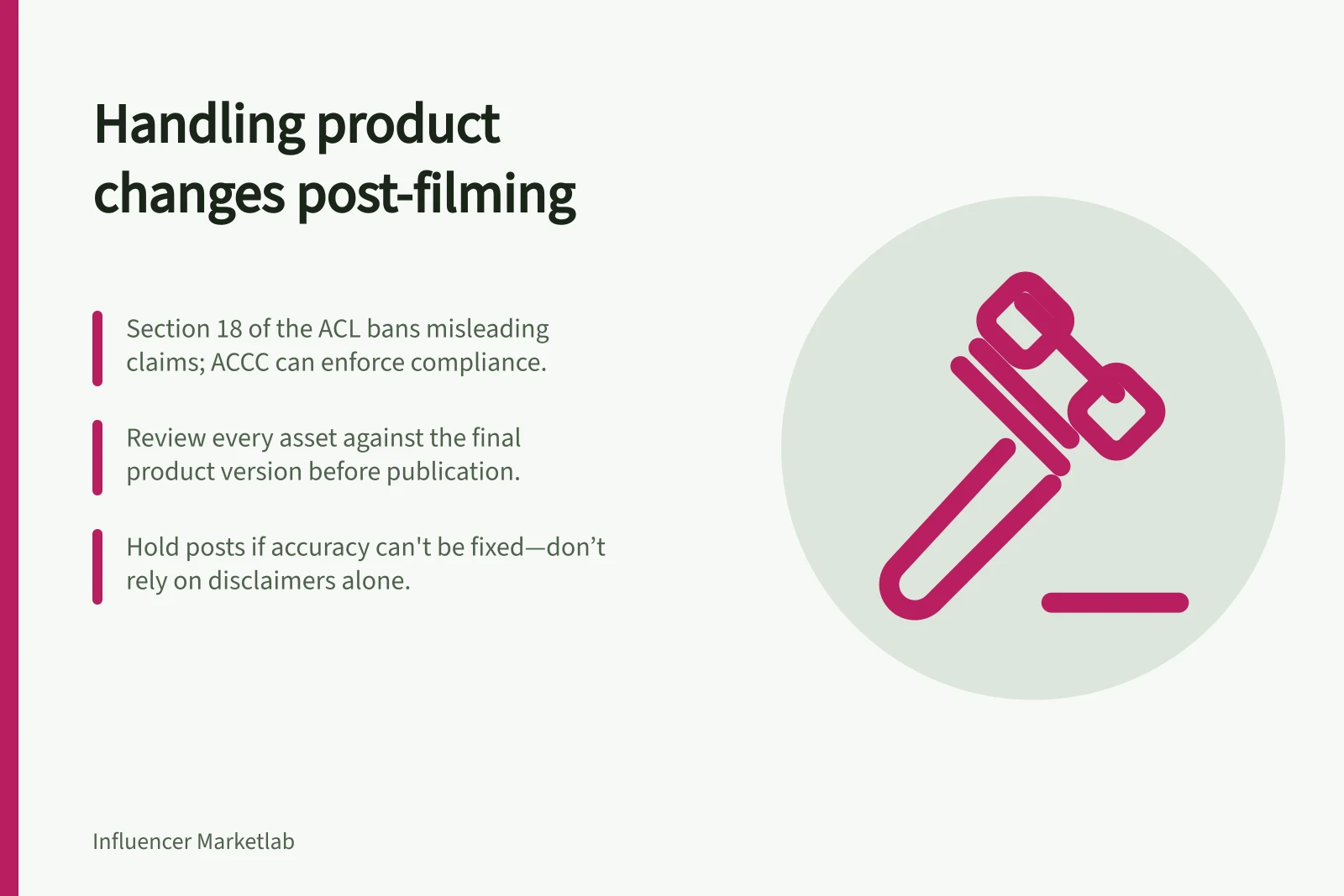
Section 18 of the Australian Consumer Law (ACL) prohibits conduct that is misleading or deceptive, or likely to mislead or deceive. The ACCC provides general consumer-law guidance, can require businesses to back up social media claims, and may investigate and take compliance or enforcement action over false or misleading social media advertising.
Make the decision with the creator. Approval of the old asset does not establish that a new product claim is accurate.
Identify the change in every asset
Get a dated change note from the product owner. Name the affected model, feature, accessory, price, packaging, availability or delivery information. For each affected asset, record the changed fact and the original claim or visual it affects. Review spoken words, on-screen text, demonstration, caption, cover image and destination; a feature can be visibly demonstrated even if it is never named.
For every asset, compare each claim and visual with the updated product information. Mark what remains accurate, what can be corrected and what cannot be supported by the information available.
Finding / Next action
- The change does not affect what viewers see or hear
- Record the review and retain the approved asset.
- A short edit can remove the inaccurate impression
- Agree the edit and review the complete post again.
- The demonstrated result or product identity has changed
- Discuss new footage or a different angle with the creator.
- Accuracy cannot be restored before publication
- Hold the post.
Choose an edit or hold
A small disclaimer may not fix a video that still shows a feature customers will not get. If an edit can remove or correct that issue clearly, revise the asset; if not, hold publication until new footage or another accurate piece is ready.
If filming used a prototype, explain material differences from the retail version before asking the creator to review new copy. A creator can identify a verified specification supplied by the brand while making clear which unit they actually used.
If the difference makes the demonstration misleading, arrange access to the changed product or choose another piece of content.
Agree the revised work
Send the creator the change note and proposed remedy. Ask what can be corrected in the existing file and what needs more production. Record agreed changes to deliverables, publication date, revision rounds and payment. The Australian Government’s business.gov.au contractor page, “Prepare a contract”, lists “Document contract variations” as step 13.
Tie the brand's factual approval and the creator's approval to the same revised asset. Check that editors and anyone managing a scheduled upload have that version. If a post is already live, assess its audience-facing claim promptly and coordinate a correction, destination update or removal as appropriate. Keep a record of the original claim, changed product fact and action taken.
Key Compliance and Process Metrics
- Contract Variation Step
- Document contract variations (Step 13)
- Brand Approval Requirement
- Must align with creator’s approval of same revised asset
- Post-Launch Action
- Assess audience-facing claim; correct, update or remove as needed
Decide whether the piece still helps customers
New footage is useful only if the creator can honestly show the updated product and the revised piece still answers a customer question. Sometimes an accurate brand update is more useful than rebuilding a creator's personal recommendation. If the creator's assessment no longer applies, pause the piece and agree on a new purpose before more work begins.