Creator Sourcing
Part of Checking influencer audience quality
Reading comment quality without guessing engagement fraud
Read creator comments for relevant questions and useful replies while avoiding unsupported claims of engagement fraud.
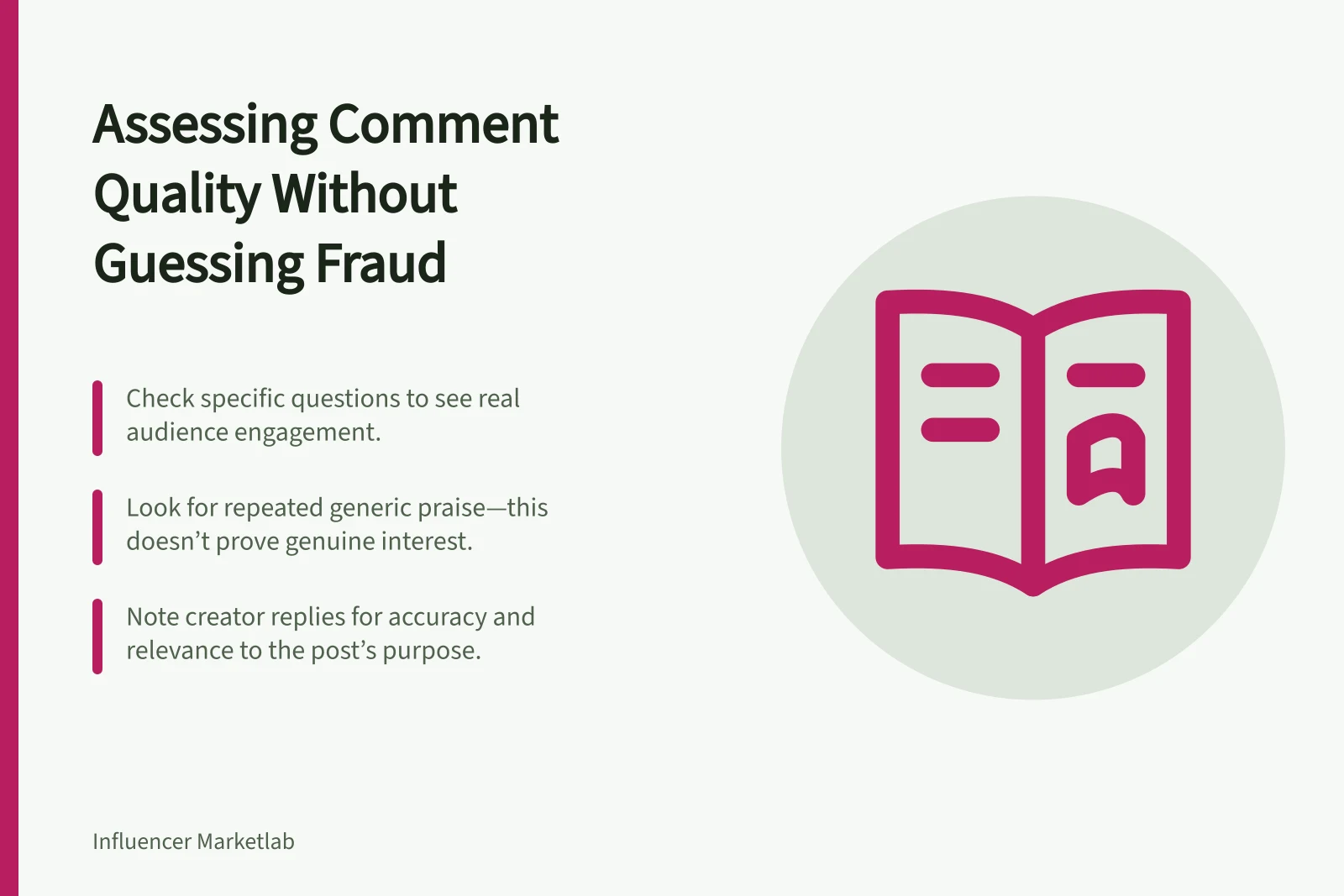
Read comments to learn what a post prompted people to ask or discuss. They cannot tell you how many genuine buyers a creator has. Sample relevant posts, examine the context and note how the creator replies. An unusual thread can justify a follow-up.
Sample the conversation
Choose several recent posts close to the format you might commission. Include ordinary and sponsored work where available, and note each post’s topic and date. Read prominent and later comments. Keep an unusually popular post in the sample without letting it stand for every post.
Judge comments against the content’s job. Questions about setup or compatibility may be useful on a product demonstration. Jokes and brief reactions may be natural on an entertainment post. Longer comments are not automatically better.
| Observation | What it may show | What it cannot show |
|---|---|---|
| Specific questions about the subject | Some commenters engaged with the topic. | How many viewers share the need. |
| Repeated generic praise | The visible thread gives little evidence of topic interest. | That comments were purchased. |
| Similar wording across posts | A reason to seek context or widen the sample. | Who wrote the comments or why. |
| Careful creator replies | How the creator handled the questions shown. | How every future question will be answered. |
A quiet thread is not automatically weak; many viewers do not comment. A busy one may reflect a competition, disagreement or a subject unrelated to your offer. Read it alongside the post and the proposed campaign task.
When comments are switched off, restricted or filtered, record that. Treat the visible thread as incomplete; do not infer why without asking.
Follow up without an accusation
If a pattern matters, ask about the relevant posts. Was there a request for comments, a collaboration, a competition or moderation that affected what is visible? Seek context without asking for private commenter identities. Record any uncertainty the answer does not resolve.
TikTok identifies fake engagement as a form of deceptive behaviour, and YouTube’s support page is titled “Fake engagement policy”. Repeated emojis, unusual names and copied phrases are not enough to label a creator or commenter fraudulent.
Platform Policies on Fake Engagement
- TikTok stance
- Fake engagement is a form of deceptive behaviour.
- YouTube policy
- Officially titled 'Fake engagement policy'.
Use comments for a bounded decision
Record concrete audience questions a commissioned piece could answer and whether the creator’s replies were useful and accurate. Pair that qualitative reading with comparable post results and any location evidence the brief requires. If comments are the only positive signal for an Australia-dependent booking, ask for location evidence separately.
Write what you observed rather than assigning an invented engagement-quality score. If a material concern remains, request more evidence or choose another brief.